Pauline’s transition from captive to comrade
American WomanPauline’s transition from captive to comrade is not a single conversion scene but an unsettled change in status, agency, and belonging. The group presents her confinement as comparatively humane, while Pauline eventually describes herself as more committed than some of her captors. Jenny’s observations complicate that claim: Pauline’s increasing participation does not erase the captivity that preceded it, or the frictions that continue to shape life among the group.
Captivity and Its Public Account
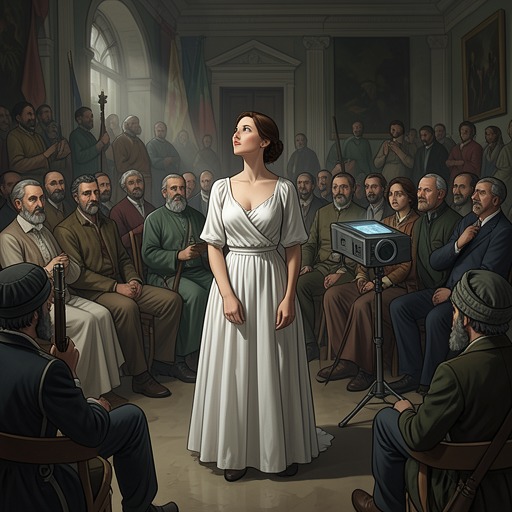
In communiqués, Juan had portrayed the group as treating Pauline better than the Geneva Conventions prescribed: she could exercise, read newspapers, and eat with her captors. He also acknowledged that she had been blindfolded at first so she could not identify them, describing this as standard protection. The contrast between those explanations matters to Pauline’s changing position. Her circumstances are discussed through the group’s account of its conduct, even as the question of her confinement remains part of the relationship between her and the people around her.
Pauline later challenges the idea that she is simply a helpless prisoner. She says that she could take a car and leave, and presents her continued presence as evidence that her commitment exceeds that of others. Her declaration marks a meaningful change in how she claims agency: she speaks not only as the person held by the group, but as someone who has chosen its cause. Yet the scene does not establish that her earlier captivity has ceased to matter. Jenny has heard the group debate the closet, and Yvonne objects when Jenny presses Pauline to speak for herself. Pauline’s assertion of commitment therefore coexists with conflict over who may define her experience and what her apparent freedom proves.
The Group’s Uneasy Boundaries
The shift is also registered through ordinary group interactions, where inclusion is neither complete nor stable. After a dispute involving the deaths of comrades, Jenny overhears Yvonne accuse Pauline of having been too slow to provide cover. Pauline responds with grief rather than accepting the accusation as a simple verdict on her loyalty. Yvonne’s manner then softens as she tries to comfort her. Their exchange reveals a group in which emotional care and political blame occupy the same conversation; Pauline is close enough to be held responsible, but that closeness does not spare her from reproach.
Later, Juan invites Jenny to join a war game and pair with Pauline. Pauline’s face darkens, and Jenny notices how tensely she sits while Juan urges Jenny to exercise for the revolution. The moment suggests that Pauline’s place in the group is bound up with comparisons and competing claims on attention. Jenny is not simply observing Pauline’s integration from outside: her arrival changes the arrangement between the others, and Pauline’s response makes that tension visible without resolving it.
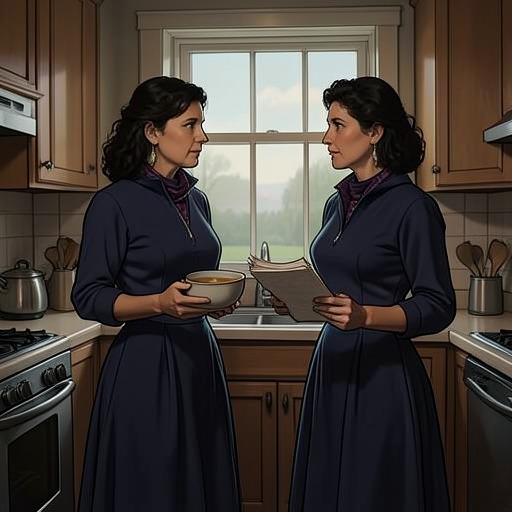
Jenny eventually recognizes a related feeling in herself. During the days when Pauline is no longer simply a captive but not yet fully a comrade, Jenny had wondered whether Pauline experienced the same uncertain position Jenny now feels: neither securely inside the group nor wholly outside it. When the others share a private game of notes during Pauline’s temporary deafness, they offer her the materials to take part, but Jenny realizes that what matters is the sense of the three acting as one. The episode gives the transition a social measure: access to the group is not identical to belonging within its shared intimacies.
Evidence of a Prior Rebelliousness
Pauline’s history also resists a neat account in which political commitment begins only with captivity. She brings Jenny a carefully preserved pile of press clippings kept in a document envelope addressed to Frazer. The magazine features offer broad, image-heavy accounts of Pauline’s case; the newspaper pieces attend to earlier incidents in her life. They report that she was expelled from a convent boarding school for sneaking out and talking back to a nun, and that she lost a restaurant job after supporting busboys who sought the minimum wage.
The coverage had already framed Pauline as a possible family rebel before she publicly embraced her captors as comrades, though that image competed with her public identity as a dedicated tennis player. A clipping published after the shootout asks whether police and federal agents distinguish between victim and captors; earlier headlines consider her resemblance to the people who kidnapped her. These press accounts do not settle what Pauline believes, but they complicate the idea that her politics were simply imposed on her during confinement. The archive makes her transition part of a longer, publicly interpreted history, while also showing how readily the media turn a person into competing roles.
From Shared Work to Political Reassessment
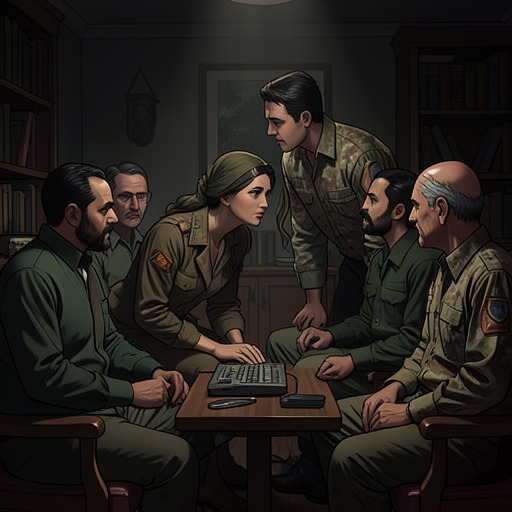
As the group works on a book, Pauline’s participation becomes part of a collective political practice. The members cannot easily agree on an opening statement: each premise leads to demands for further proof and a longer examination of history. Their debate ranges from the United States’ involvement in Vietnam to French colonial rule, postwar borders, and the nation-state. Jenny observes that their careful reconstruction of the past leaves them giving less attention to the present. Pauline is therefore associated not just with a declared allegiance, but with the labor, disagreements, and delays through which the group tries to formulate its politics.
After the group’s violent collapse and Pauline’s escape from that political world, her experience does not simply end her involvement in collective action. She and Jenny begin teaching other women about firearms, initially through the study of parts, ballistics, weapon categories, and maintenance. Pauline wants women to understand weapons rather than use them to injure or kill. Jenny finds pleasure in learning alongside Sandy, Joanne, and Lena, including dismantling a 12-gauge shotgun with pipe cleaners and household rags. The shared lessons give Pauline’s political development a different form: knowledge is approached as something women can acquire together, without pretending to know it already.
Their later discussions turn from practical instruction to who leads political movements. Pauline argues that women have too often followed men, including in revolutionary movements, and connects that pattern to the way she was taken captive and to William’s methods. Jenny resists explaining political conduct as predetermined by sex, comparing that claim to treating housework as women’s nature. The disagreement shows that Pauline’s change of allegiance is not a final, uncomplicated arrival at political certainty. Her experience among the group becomes material for reconsidering its methods and its gendered assumptions, while her continued work with other women preserves a commitment to collective change in a form distinct from the group that once held her.